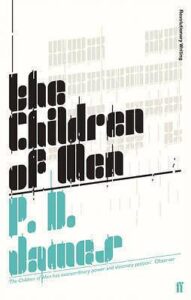
 WHOA. I was not expecting to read this book in two sittings, especially as I had a false start a couple of weeks ago where I didn’t make it past the third chapter.
I can’t help but compare this to Atwood’s The Handmaid’s Tale, especially because of the epistolary nature of the novels, but there are some major differences. Whereas religion (or pseudo-religious societal strata) is the primary driver of Gilead’s society, religion in The Children of Men is used more as a basis for anti-government unification. James’ did a better job of attempting to address racism than Atwood did (writing 10+ years earlier). Both had “castes” of minority characters, the Marthas in Atwood and the Sojourners in James, and whereas it’s more of a passing reference that the Marthas are black and nothing more is mentioned in James one of the key tenants of the “resistance” is that the Sojourners (often immigrants from poor countries—think Windrush generation) be treated with respect and allowed to stay and grow old in the UK.
That being said, for me the book took a little too much of a religious turn toward the end. It wasn’t over the top but it definitely felt like it could turn into a super religious story if James had written a sequel. For the most part the book was agnostic, there were references to religion and trying to find the reason no more children were being born, but it was, of course, someone religious who ended up having the first baby in decades.
After all, if our sex life was determined by our first youthful experiments, most of the world would be doomed to celibacy. In no area of human experience are human beings more convinced that something better can be had if only they persevere. (25)
The speculative nature of the work and its similarities to Atwood’s The Handmaid’s Tale can’t be stressed enough. It’s amazing this one isn’t mentioned in the same breath as that and Orwell’s 1984. I guess because it’s written so much more recently it’s “old news” at this point, but the characters made it unique and James wrote about a population that the other two seem to overlook or ignore (or most likely are killed off early in the dystopian establishment). It was not in the least bit surprising that the only people that could reproduce would be the ones that society deemed unfit to even test for fertility. The child that is born comes from a woman who was born with a deformed hand and a man who had seizures, both of whom were excluded from testing.
The only other thing I’ll note in this mess of a book was Chekhov’s gun. The second shooting as a sport was mentioned by the main character and how he was better than his cousin the Warden of England, I already knew how the book would end. I wasn’t sure when or how it would end, but I knew that was not a throw away line. Ultimately, James let the story to the inevitable and left the entire next chapter of the world up to the reader.
Recommendation: What a depressingly hopeful novel. I had no recollections of what the story was about and it took a while to get into it. That being said, when it really kicked off it captured my attention and I couldn’t put it down. This feels like an alternate history of the world Atwood creates in The Handmaid’s Tale and The Testaments and even shares a major similarity (you’ll have to read both to confirm). The characters were interesting and the epistolary portion for the first 2/3 gave a lot of insight into the main character, but there were definitely some slow moments that I had to power through.
Opening Line: “Early this morning, 1 January 2021, three minutes after midnight, the last human being to be born on earth was killed in a pub brawl in a suburb of Buenos Aires, aged twenty-five years two months and twelve days.”
Closing Line: “It was with a thumb wet with his own tears and stained with her blood that he made on the child’s forehead the sign of the cross.” (Whited out to avoid spoilers, highlight to read.)
Additional Quotes from The Children of Men
“Ageing is inevitable but it is not consistent. There are plateaux of time stretching over years when the faces of friends and acquaintances look virtually unchanged. Then time accelerates and within a week the metamorphosis takes place. It seemed to me that Jasper had aged ten years in a little over six weeks.” (65)
“There was nothing worth transferring from the Rover to the Renault except is road maps and a paperback edition of Emma, which he found in the glove box. He slipped the book into his inner coat pocket which held the revolver and his diary.” (232)