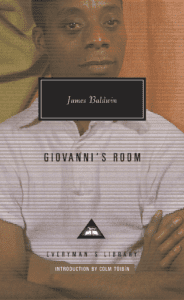
 For the second book of our virtual book group this year we read Giovanni’s Room. This is also the second novel I’ve read by James Baldwin and it was a totally different experience. Oddly enough, there was a similar trajectory as Sedaris’s Dress Your Family in Corduroy and Denim, when I last read Baldwin it was towards the end of my undergrad career where I read Go Tell It on the Mountain for an Intro to LGBT Literature class my senior year.
Going into this I was a little wary as I found my first introduction to Baldwin to be a struggle. I wasn’t a fan of his cyclical story telling and the repetitive nature. I’ve watched interviews he gave and it was how he spoke which was natural and easier to follow, but when it comes to reading it, I struggled so much to follow the story and stay engaged.
Thankfully, this was a different experience and it makes me want to maybe go back and revisit Go Tell It on the Mountain to see if I can appreciate it more now. I don’t know if it’s growth and life experience that made this novel so much more approachable for me (both mine and Baldwin’s) or if it was easier to identify with the characters because they were white men closer in age to me than a young black religious boy growing up in Harlem. Either way Baldwin’s talent shone in this novel.
For me this novel was bittersweet and full of melancholy. I didn’t like any of the characters, but I don’t think you were supposed to. None of them have redeeming qualities and you can read it from any perspective you want, but at the end of the novel we’re still seeing and interpreting everything through Nick, which colors every aspect of the work. He’s repressed his same-sex desires for decades except for the occasional outburst of passion and sexual activity, but he’s never once allowed the idea that love could happen between two men to exist in his being. This refusal is sorely tested when he meets Giovanni and they fall into a love-at-first sight but also of convenience, for a few months of passion which everyone can see except Nick, because he refuses to see it or even really acknowledge it.
‘Love him,’ said Jacques, with vehemence, ‘love him and let him love you. Do you think anything else under heaven really matters? And how long, at the best, can it last? since you are both men and still have everywhere to go? Only five minutes, I assure you, only five minutes, and most of that, hélas! in the dark. And if you think of them as dirty, then they will be dirty—they will be dirty because you will be giving nothing, you will be despising your flesh and his. But you can make your time together anything but dirty; you can give each other something which will make both of you better—forever—if you will not be ashamed, if you will only not play it safe.’ He paused, watching me, and then looked down to his cognac. ‘You play it safe long enough,’ he said, in a different tone, ‘ and you’ll end up trapped in your own dirty body, forever and forever and forever—like me.’ And he finished his cognac, ringing his glass slightly on the bar to attract the attention of Madame Clothilde. (55)
I was a little frustrated with the book group discussion in that it felt the majority of people wanted the story to be told from Hella (Nick’s girlfriend/fiancée) or Giovanni’s point of view and that to me would’ve destroyed the story. As I was starting to write this post I looked at the data tags of the novel and it being classified as psychological fiction is actually very important to the work and I hadn’t thought about it that way. Because we are seeing things solely through Nick’s point of view, we don’t know anyone else’s thoughts. We only know what Nick shares, sure Hella and Giovanni could be sympathetic characters, she comes across flat, he comes across as manipulative, sad, or even deranged.
If the story were reversed would we get any of Nick’s inner turmoil. It’s not explicit and it’s not easy to pick up on, as can be seen by most people stopping at calling him a narcissist and not going any further, but it is there. Perhaps Baldwin’s mastery was not in the beautiful language, but in the way Nick’s inner turmoil plays out solely through his actions across the story. His treatment of other characters with wanton disregard to their feelings or situations is the same way he treats himself. This only comes to me a few weeks after discussion where I did posit that I think the actual titular room might’ve been Giovanni’s acceptance of his same sex desires, as they begin to look like they might last or stay together he slowly works to clean and repair the room, but the second it looks like their romance is over he begins to let it fall into disrepair again.
Recommendation: This book is not for everyone, but it is an incredibly beautiful and well crafted work that will stay with me for a long time. As narcissistic and self-loathing as Nick comes across and as flat as so many of the other characters are, I feel Baldwin had so much to say in this novel that he was able to get across in so few pages comparatively. His way with words and the scenes he wrote—in what really isn’t that long of a time span, we’re talking less than a year, and how powerfully it impacted the characters—will randomly pop into my head for years to come (like Jamie O’Neill’s At Swim, Two Birds or Kazuo Ishiguro’s Never Let Me Go).
Opening Line: “I stand at the window of this great house in the south of France as night falls, the night which is leading me to the most terrible morning of my life.”
Closing Line: “Yet, as I turn and begin walking toward the waiting people, the wind blows some of them back on me.” (Whited out to avoid spoilers, highlight to read.)
Additional Quotes from Giovanni’s Room
“Then, for the first time in my life, I was really aware of another person’s body, of another person’s smell. We had our arms around each other. It was like holding in my hand some rare, exhausted, nearly doomed bird which I had miraculously happened to find. I was very frightened; I am sure he was frightened too, and we shut our eyes. To remember it so clearly, so painfully tonight tells me that I have never truly forgotten it. I feel in myself now a faint, a dreadful stirring of what so overwhelmingly stirred in me then, great thirsty heat, and trembling, and tenderness so painful I thought my heart would burst. But out of this astounding, intolerable pain came joy; we gave each other joy that night. It seemed, then, that a lifetime would not be long enough for me to act with Joey the act of love.” (9)
“Or she knits. It seems to me that she was always carrying a great bag full of dangerous-looking knitting needles, or a book, or both. And I don’t know what she knitted, though I suppose she must at least occasionally, have knitted something for my father, or me. But I don’t remember it, anymore than I remember the books she read. It might always have been the same book and she might have been working on the same scarf, or sweater, or God knows what, all the years I knew her.” (13)
“‘If dirty words frighten you,’ said Giovanni, ‘I really do not know how you have managed to live so long. People are full of dirty words. The only time they do not use them, most people I mean, is when they are describing something dirty.'” (77)
“Then something opened in my brain, a secret, noiseless door swung open, frightening me: it had not occurred to me until that instant that, in fleeing from his body, I confirmed and perpetuated his body’s power over me. Now, as though I had been branded, his body was burned into my mind, into my dreams.” (135)