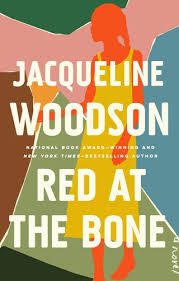
 Jacqueline Woodson’s Red at the Bone hit me in a way that I wasn’t expecting it to. To be honest, I had no idea what to expect going into it, but that was the whole point of joining the online book group of knitters: read books outside of my comfort zone and get to have discussions about them.
The premise of the novel is that two families of different classes are tied together by an unexpected pregnancy. As Melody, the child that ties them together comes of age, we look backwards and forwards through her parents’ eyes (Iris & Aubrey) and her grandparents’ eyes (Sabe & Po’Boy). Like one of the endorsements on the book says, Woodson’s story packs so much more into what is a relatively short novel and it’s not wrong. I read the entire novel in one sitting on a 3.5 hour flight and had plenty of time to spare.
As I started the novel, I wasn’t sure I was going to get into it due to its non-linear nature and the fact that it started with “But . . .” and growing up we were told NEVER to start a sentence with a conjunction, let alone a book! However, Woodson’s storytelling and cadence, as well as the uniqueness of each character’s voice quickly pulled me into the intergenerational story. From the hard-headed this is my day, this is my moment chapter of Melody to the stayed matriarchal chapters of Sade to the almost monotonous, resigned (?) chapters of Iris, this story is really the story of these women and the men who surround them.
I had very little patience for Iris throughout the first half of the novel. I’m not sure if it was because of the way she moved through her life, almost as if she was an observer and others didn’t have any impact on her and this came across as incredibly selfish and self-centered from her relationship with Aubrey to her pregnancy to going off to school. They were all things that happened to her and she walked away from. This changed, however, when she met and had a relationship with Jamison in college. It was at this point that someone walked away from her for the first time and forced her to grow up, to realize how she’d treated others, how she’d prioritized only herself up to that point and it was then that I began to feel some empathy toward her.
If there was one chapter I wish would’ve been written, it was one from CathyMarie (Aubrey’s mom). I understand why it wasn’t written, she’s dead by time Melody’s coming-out party that opens the book takes place, but I still would’ve liked to hear her story as I feel it would be just as powerful as any of the other women’s stories just from what we know with the flashback mentions.
I believe in words, she said. I believe in numbers and all the history I understand. I believe in things I can see. When he was a little boy she used to hug him and say, And man-oh-man how I believe in you, Aubrey. My love. My Light. My Life. (73)
Where Woodson excelled, aside from the depth of her characters was tying hyper-local events and world-events to the story in a way that whether you’re a woman, whether you’re black, whether you’re American, whether you grew up in a rural or urban setting, or whether you’re of the same generation as anyone in the story, you are able to find a connection of some sort to the story. The way that she wove historical events—both those that have international impact and those that only locals would know—into the story was seamlessly beautiful. From the inherited generational trauma of the Tulsa Massacre to the televised trauma of 9/11, Woodson incorporated these events in a way that was personal and emotional but not voyeuristic or cheap.
As the novel wrapped up, there wasn’t a neat perfect ending, but it was the perfect ending for Melody and Iris. We don’t know what their relationship is or will be, but we know that they’re at least together in the moment. We know that they’ve witnessed and confirmed and become part of the family legacy (note the irony on that re: sorority legacy) and are a part of the long line of ancestors that brought them to that very moment.
Recommendation: 100% recommend. I’m writing this a few days after I finished and there are still moments of the story that I’m digesting and turns of phrases that keep bubbling up in my thoughts. Woodson’s writing is deceptively simple and filled with lyricism that often felt like it was a lullaby or a ballad depending on whose chapter it was. The interweaving of five different views of the same event with tendrils of stories moving forwards and backwards definitely required an adjustment, but after 3-4 chapters I was captivated and fully invested.
Opening Line: “But that afternoon there was an orchestra playing.”
Closing Line: “In the empty house with everyone but the two of them gone now, there it is. Gleaming.” (Whited out to avoid spoilers, highlight to read.)