 I’ll rip the band aid off quickly—this book was not for me.
It wasn’t a bad book, there were some incredibly beautiful passages that I sat with for a minute or two as I read them, but it was just too much of everything for me. I’ve had this on my bookshelf since 2014! What’s wild is that I picked it up off a table outside of the Harvard Graduate School of Education, where you paid based on the honor system, and 10 years later I graduated from a program from there, wild how the world works.
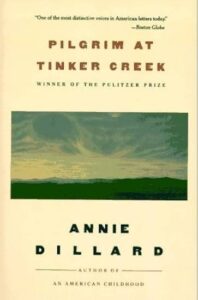
This was one of those books that I’d always heard about, I mean it won a Pulitzer Prize, but I’d never read so when I saw it back then I grabbed it. I was obsessed with prize winners (especially the Booker), but I never got around to reading it. However, when Annie Dillard died earlier this year I pulled it off my shelf and set it out to read.
I don’t want to say the book was too naval gazing for me, because Dillard barely wrote about herself, she mostly wrote about the world around her, but with the center point being her experience. And that’s not a bad thing, not at all, it just felt like it went on for too long. Obviously, I must’ve missed something because it won a Pulitzer and it has so many five star reviews everywhere, which is great and I’m sure it deserves them. It just means it wasn’t for me.
What I really enjoyed about the book was the disparate subjects she pulled in as she was looking at the natural world. From biology and geology to theology and philosophy the depth and breadth of the novel were phenomenal and there’s no doubt in my mind that Dillard was an incredibly intelligent and well read individual. But with all of that crammed into a relatively short book (under 300 pages), it got very dense at times and became one of those books you should read but not one you want to read. I did really appreciate that she constantly circled back to subjects she’d previously discussed so even at the end of the novel the seemingly asynchronous opening was wrapped up nicely.
Recommendation: This one wasn’t for me, but it could be for you. I found Dillard’s writing at times incredibly crisp and concise while still remaining beautiful, but then at other times found it so dense I was nodding off. After hearing that there was quite a bit of spirituality and philosophy in the book I was a little reluctant to start reading it after her death, but I actually found those parts not to be too over the top or overwhelming. This is what I imagine Thoreau’s On Walden Pond is like but with more modern science and thoughts included (they may be nothing alike, but mentally that’s where I was going in and still was coming out of the book).
Opening Line: “I used to have a cat, an old fighting tom, who would jump through the open window by my bed in the middle of the night and land on my chest.”
Closing Line: “And like Billy Bray I go my way and my left foot says ‘Glory,’ and my fight foot says ‘Amen’: in and out of Shadow Creek, upstream and down, exultant, in a daze, dancing, to the twin silver trumpets of praise.” (Not whited out as this is a work of nonfiction.)