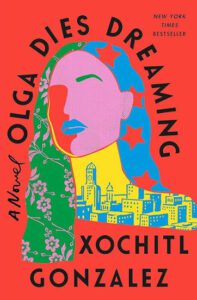
 I had no clue what to expect going into this one. The virtual knitting/book group that I’m a part of selected it in honor of Hispanic Heritage month and I jumped right in about a week before the book group meeting. This is a messy review, I should’ve written it right when I finished the novel and not two weeks later. It’s more stream-of-consciousness than usual and definitely scattered AF. Not sure anyone is still reading the full reviews, so I’m not going to worry about it too much.
Olga Dies Dreaming is a family drama at heart. Sure there’s politics and social/class discussions and revolution and race and appropriation, but at heart it’s about family. Who did what to who, who didn’t support who and who, ultimately, did the family wrong. I didn’t think I would get sucked in as fast as I did with a relatively boring opening line about napkins, but man I was here for the drama and waiting to find out what Mabel thought about Olga’s “present” for her wedding.
I found both Olga and Prieto to be strong characters. They were running parallel lives while simultaneously running to and from their perceived relationship with their mother, a revolutionary activist who left them when they were young to pursue a greater good.
Prieto’s story was heartbreaking and I felt more complex than Olga’s at first glance, but they both were wheeling and dealing their way through life. Where Prieto went the political/public figure route and paid for it dearly staying in the closet and being blackmailed to vote against his community (both New York and Puerto Rico) on numerous occasions, Olga went the other way with shady dealings skimming off the top of her wedding business and ultimately making deals with the Russian mob.
The character I wanted to know more about, but also didn’t want to know anything about was Blanca, their mother. She believed in something so much that she abandoned her children to pursue freedom for Puerto Rico. And, even though she abandoned them, she continued to pull the puppet strings around them through letters and contact points across their lives.
The most satisfying point of the novel was in the final few chapters when they finally realized what she’d been doing and they pooled all the letters Blanca sent to her family and got the full narrative and saw just how manipulative she’d been.
What the story really made me want to do was read more about Puerto Rican history post-1800s. I realized that most of the history that I know/remember is pre-1800 and so much has happened in the last 220+ years! Setting the story in the diaspora at the same time Irma and Maria devastated the island brought the colonial experience into real time and into times that I’ve lived in.
Recommendation: 100% worth reading. I had no expectations going into it but was drawn in and absorbed by the story and couldn’t get through it fast enough. I would absolutely pick up something by Gonzalez again if I saw her name on a shelf. She wrote realistic characters that were easy to identify with, but weren’t perfect. They had flaws, they had real issues, but they worked through some of them and others they just had to live through and hope things got better.
Opening Line: “The telltale sign that you are at the wedding of a rich person is the napkins”
Closing Line: “She hung up, dropped the new phone into the nearest gutter, and got on the R train so she wouldn’t be late for dinner. It was a glorious fall day. Matteo was going to grill.” (Whited out to avoid spoilers, highlight to read.)