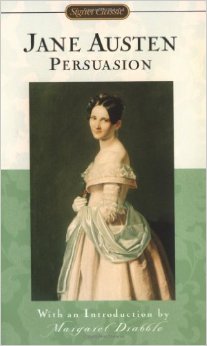
 And with that I have completed my re-read of Austen in celebration of her 250th birthday. I just missed timing it for her actual birthday by 3 days finishing (I finished on the 19th), but my ultimate goal was by the end of 2025 and I did that with room to spare.
As a reminder I re-read all six novels plus an adaptation of each—you can find the full list in my 2025 Q1 Recap post—and it was reading the Persuasion adaptation Yours, Eventually by Nura Maznvai that set the whole thing off!
Re-reading Persuasion this year reminded me why it is one of my favorite novels, but also one I am the most sad about. Austen wrote it toward the end of her short life and didn’t have enough time to revisit and refine it, something that Margaret Drabble notes in the introduction in depth. This particular line stands out to me and reiterates why I like it so much:
Mellow it may be, but it is not weak. Its author while she was writing it may have suspected herself to be seriously, even fatally ill, but this is no dying fall. (Introduction, xix)
Well that and I’m a sucker for second-chance romance. The long separation between and growth of Anne Elliot and Captain Wentworth just make it that much more rewarding and readable. I can only imagine how less rushed it would’ve felt if Austen had the opportunity to revisit it because the movement and quickness of the novel and the lightness of her writing bring back the ease with which Pride and Prejudice flows and I like to think she would’ve fleshed out a few of the characters and had less of a rushed ending.
No second attachment, the only thoroughly natural, happy, and sufficient cure, at her time of life, had been possible to the nice tone of her mind, the fastidiousness of her taste, in the small limits of the society around them. (48)
It’s funny to me that although the readability of this is more aligned with the light and flowy nature of P&P, it also has pieces of each of the other novels in it. From Sense and Sensibility it has Marianne’s sensibility and belief that no other but the first love will ever last; from Mansfield Park it has the deference and meekness of Fanny and her horrible treatment by family (or so it seems) in Anne’s relationship with her father, elder sister and even, on occasion, Lady Russell; and from Northanger Abbey and Emma the ridiculous rigidity of hierarchy and societal/class standards in how so many characters in this novel are obsessed with the waning importance of nobility and rank; and more so from Emma the slight obsession with health and sickness. Austen has evolved her themes to be both more expansive and somehow more pointed without resorting solely to caricatures or over the top exaggerations.
Yet, she also continued to write such unlikeable characters that even the dullest or those heroines who have grown old and lost their bloom stand out as bright and beautiful. I don’t know how anyone could defend Sir Elliot (Walter or the future William) or any of the others who are so nasty and mean because of their rank and privilege.
He longed to see her. He hoped she might make some amends for the many very plain faces he was continually passing in the streets. The worst of Bath was the number of its plain women. He did not mean to say that there were not pretty women, but the number of the plain was out of all proportion. He had frequently observed, as he walked that one handsome face would be followed by thirty, or five-and-thirty frights; and once, he had stood in a shop in Bond Street, he had counted eighty-seven women go by, one after another, without there being a tolerable face among them. (164)
It’s actually refreshing to see Jane push back and judge those characters harshly whether through comedy or through where they end up in the novel: alone, married to other horrible characters or just written off in general. She’s less concerned with their fates than the success of those that are not only the protagonists, but those that are moral (see continued themes carried forward) and charitable like Anne and Mrs. Smith. It’s worth noting that Mrs. Smith, the one so harshly judged by Sir Walter and Elizabeth Elliot, has more of a send off than the former two or the other ‘villains’ of the story William Elliot and Mrs. Clay.
Austen once again highlights her thoughts on lack of education or allowance for female independence and voice in this novel, perhaps not as saucily as with her comments on the “governess trade” in Emma or female education in general in Mansfield Park, but she does have Anne voice her thoughts on lack of female voice in authorial content:
Perhaps I shall.—Yes, yes, if you please, no reference to examples in books. Men have had every advantage of us in telling their own story. Education has been theirs in so much higher a degree; the pen has been in their hands. I will not allow books to prove anything. (264)
Recommendation: What a wonderful novel to end my re-read of Austen’s works this 250th year of her birth. I found Anne and Captain Wentworth’s story just as good as the first time I read it and found even more parallels between this and her other novels than I’d previously found that showed Austen’s growth as a writer and a story teller. There are moments that I feel Austen would’ve 100% spent more time on adding detail to or context to that could only have improved the story of long held devotion and much delayed reconciliation between the two characters, but unfortunately she died just under a year after she completed writing and revising it the first time.
Opening Line: “Sir Walter Elliot, of Kellynch Hall, in Somersetshire, was a man who, for his own amusement, never took up any book but the Baronetage; there he found occupation for an idle hour, and consolation in a distressed one; there his faculties were roused into admiration and respect, by contemplating the limited remnant of the earliest patents; there any unwelcome sensations, arising from domestic affairs, changed naturally into pity and contempt.”
Closing Line: “She gloried in being a sailor’s wife, but she must pay the tax of quick alarm for belonging to that profession which is, if possible, more distinguished in its domestic virtues than in its national importance.” (Whited out, highlight to read.)
Additional Quotes from Persuasion
“He had, in fact, though his sisters were now doing all they could for him, by calling him ‘poor Richard,’ been nothing better than a thick-headed, unfeeling, unprofitable Dick Musgrove, who had never done anything to entitle himself to more than the abbreviation of his name, living or dead.” (71)
“‘You should have distinguished,’ replied Anne. ‘You should not have suspected me now; the case so different and my age so different. If I was wrong in yielding to persuasion once, remember that it was to persuasion exerted on the side of safety, not of risk. When I yielded I thought it was to duty; but no duty could be called in aid here. In marrying a man indifferent to me, all risk would have been incurred, and all duty violated.'” (275)

Pingback: Book 1,061: Yours, Eventually – Nura Maznavi – geoffwhaley.com
Pingback: Q3-Q4 Recap 2025 (Jul-Dec) – geoffwhaley.com